Modern Art Meets the Metropolis: A Designer's Guide to Cubist Cityscape Backgrounds
When you're building a brand or a marketing campaign, the background is often the silent workhorse. It needs to support the message without shouting over it, yet it must be interesting enough to catch the eye. This is where the challenge lies. Generic gradients and solid colors can feel flat, while overly complex photographs can distract. The solution often lies in finding a middle ground—something with texture, personality, and a story. Cubist Cityscape Backgrounds offer precisely that balance, blending artistic history with a contemporary digital aesthetic.
Deconstructing the Urban Landscape
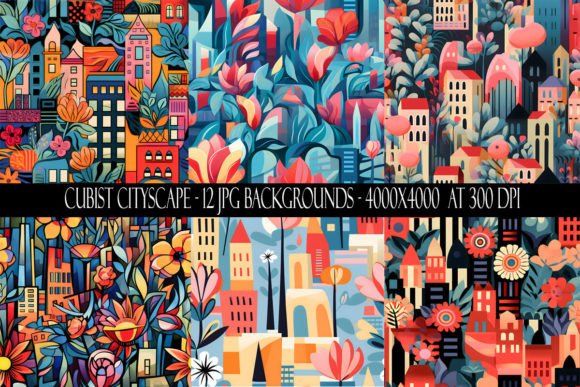
Cubism, as an art movement, was about breaking down objects into geometric forms and presenting them from multiple viewpoints simultaneously. Applying this to a cityscape creates a fascinating visual language. Imagine the familiar skyline of skyscrapers, bridges, and rooftops, but fractured into planes of color, overlapping angles, and abstract shapes. The result is a background that feels both familiar and intriguingly abstract. It’s not a literal photograph of a city; it's the essence of a city—its energy, structure, and rhythm—translated into a modern graphic style.
This collection of Cubist Cityscape Backgrounds captures that energy perfectly. The visual personality is dynamic yet controlled. You’ll find bold color palettes, strong lines, and a sense of organized complexity. It’s a style that conveys modernity, creativity, and sophistication. The appeal isn't just in the final look, but in the implied narrative; each design suggests a story of urban life, innovation, and architectural beauty, making it a powerful tool for visual storytelling.
Practical Applications Across Creative Projects
The true value of a design asset is measured by its versatility. With 12 unique JPG designs at a high resolution of 4000x4000 pixels, this pack is built for a wide range of professional and personal applications. The commercial and print-on-demand licensing removes the guesswork, allowing you to use these backgrounds confidently in projects intended for sale.
- Branding & Marketing: For businesses in tech, real estate, architecture, or creative services, these backgrounds can form the core of a brand identity. Use them for website hero sections, presentation slide decks, or as a textured backdrop for social media graphics. They provide a consistent, professional look that sets a modern tone without being distracting.
- Publishing & Editorial Design: Magazine covers, book covers, and report backgrounds often need a compelling visual hook. A cubist cityscape can serve as a striking display font backdrop for titles or as a full-page texture that adds depth and interest to editorial layouts.
- Digital Products & E-Commerce: If you sell digital planners, printable wall art, or custom stationery, these backgrounds are invaluable. They can be used to create themed collections, like a "Metropolitan" or "Urban Art" series. The high DPI (300 dpi) ensures crisp results for both print design and high-resolution screens.
- Packaging & Product Design: Imagine a coffee brand with a modern urban vibe, or a tech startup's product box. Using a cubist cityscape as a background panel can instantly communicate a contemporary, forward-thinking identity. It works exceptionally well with clean sans serif font typography.
- Personal & Craft Projects: From custom phone cases and laptop skins to printed fabric for quilting or apparel, the applications for crafters and hobbyists are endless. The non-seamless format means each design is a complete, standalone piece of art.
Strategic Considerations for Effective Use
Simply dropping a background into a project isn't enough. To maximize its impact, consider how it interacts with your other design elements. Here’s a practical guide to using these assets effectively.
Ensuring Readability and Visual Hierarchy
The foremost rule is that your text must be legible. Since cubist backgrounds are inherently detailed, they work best as a supporting element. Avoid placing large blocks of body text directly over the most active parts of the design. Instead, use the background in areas with less visual noise or apply a subtle semi-transparent overlay (a white or black box at low opacity) behind text to create a safe reading zone. This is a common technique in web design and editorial design to maintain a strong visual hierarchy.
Font Pairing and Brand Perception
The geometric nature of cubism pairs exceptionally well with certain typefaces. For a sleek, modern look, combine it with a clean sans serif font. For a touch of contrast and elegance, a simple serif font can work. Avoid overly ornate script fonts or handwritten fonts, as they can clash with the structured, angular aesthetic. The right font pairing will reinforce brand perception, making your overall design feel cohesive and intentional. For example, a financial tech company might use a bold sans serif, while an art gallery could opt for a refined serif.
Evaluating Fit and Commercial Use
Before committing, always test how a background interacts with your specific content. Place your logo, key headlines, and primary imagery over it. Does it enhance or compete? The included commercial license is a significant advantage, allowing you to use these design assets in client work, on products for sale, and across digital platforms without additional fees. The watermark is removed upon download, so you receive clean, ready-to-use files. Remember, while these are premium font alternatives in the background space, their value is realized through thoughtful application.
In a digital landscape saturated with predictable visuals, choosing a background with artistic depth can make a tangible difference. Cubist Cityscape Backgrounds provide a unique blend of art and utility, offering a professional foundation for projects that aim to stand out with a creative, urban edge. By focusing on strategic implementation—prioritizing readability, smart typography, and intentional design—you can leverage this collection to build more engaging, memorable, and effective visual communications.